In Remembrance of Kazuhito Yamashita, the Guitarist Who Proved That “The Guitar Is a Small Orchestra”
When I learned of the passing of Kazuhito Yamashita,
the only words that came to mind were, “I can’t believe it.”
Soon after, all I could do was weep.
My connection with Kazuhito Yamashita was so long-standing and profound that the word “meeting” hardly does it justice.
Even before I was born, my parents were associated with the Nagasaki Guitar Music Academy, which was founded and led by his father, Mr. Tōru Yamashita.
In that sense, Kazuhito Yamashita was someone who had been close to me since before my birth.
As we came from the same region, I attended his recitals many times from early childhood.
One performance, in particular, remains vividly etched in my memory: a recital held in a very small space within the Nagasaki Guitar Music Academy, a room that seated no more than forty people.
It felt as though the music was not simply being played, but rather welling up from within the guitar itself.
That sensation left a profound and lasting impression on me.
In general discourse, Kazuhito Yamashita is often described as a “solitary” or “reclusive” guitarist.
However, the man I knew from childhood was warm and approachable—more like an older brother who always spoke to me kindly.
When I was in elementary school, he even visited my family home on several occasions.
Each autumn, during the Kyushu Guitar Festival held annually in Nagasaki, I would eagerly play the guitars displayed in the lobby.
Almost without fail, Kazuhito Yamashita would come over to listen, and he would always say to me:
“Masahiro, you play the guitar very well.
Listen to more orchestral music—and become even better.”
When I was in fifth and sixth grade, he served as a juror at the Kyushu Guitar Music Competition and listened to my performances.
He also attended my debut recital thirty-five years ago.
The memory of going out together afterward to a post-concert gathering remains deeply precious to me.
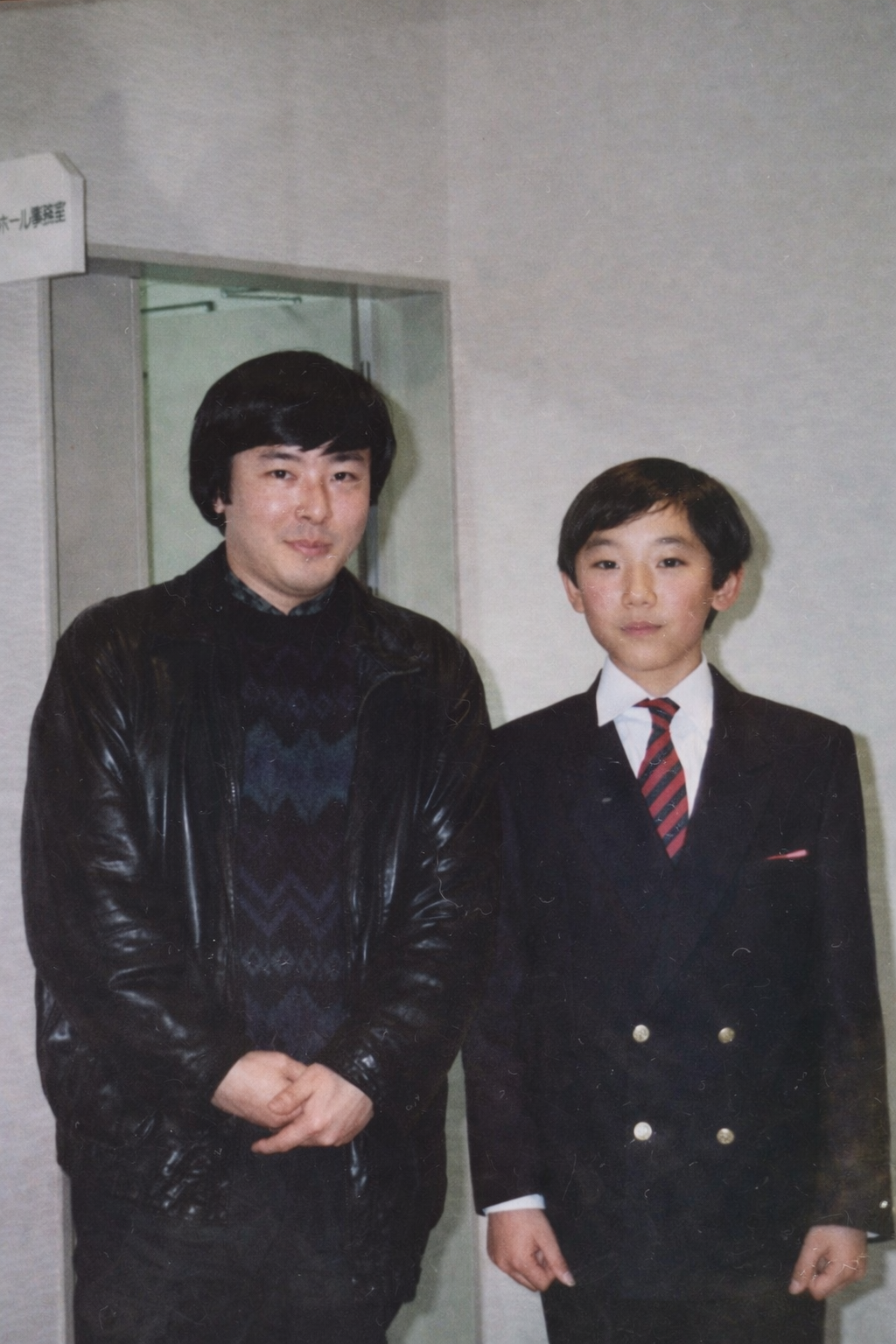
山下和仁さんと。
少年時代の益田正洋
Shortly before I left Japan to study at the Juilliard School, I happened to run into him by chance at the Nagasaki Central Post Office.
I felt an unusually intense aura of concentration and noticed a man seated at a table, completely absorbed in writing a letter.
It was Kazuhito Yamashita.
When I greeted him, he looked at me momentarily with a puzzled expression and asked, “Who are you?”
When I replied, “It’s Masahiro,” his face lit up.
“Oh, it’s been a long time! If you have time, let’s go have some tea.”
We talked for about an hour.
I believe I shared with him my anxieties about studying abroad and my frustration at feeling tense and unable to improve as I wished.
I hardly remember any specific advice he gave me.
Yet I clearly remember how strangely light my heart felt afterward, as though I had returned to my childhood.
After graduating from Juilliard and returning to Japan to live in Tokyo, I attended several more of his recitals.
The impression was exactly the same as when I was a child.
Music seemed to pour forth from his entire being.
What he envisioned was always an orchestra itself—and he expressed it with a single guitar.
The formidable technique and mental strength that supported this vision were extraordinary.
He was, in the truest sense, an artist.
On more than one occasion, I found myself unable to stop my tears after his performances.
On one occasion, when I was fortunate enough to join him at a post-recital gathering, I timidly asked him,
“What kind of practice do you usually do?”
His answer was enigmatic:
“I’ve decided that I no longer practice.”
At the time, I was bewildered.
But later, I came to think that for a musician who had already mastered the guitar so completely, this was not a rejection of effort, but a transition to something beyond what we ordinarily call “practice.”
I wish I could have asked him one day what he truly meant.
For me, Kazuhito Yamashita was—and will remain—an eternal ideal as a guitarist.
The works I have kept in my repertoire since childhood are almost all pieces that captivated me through his recitals and recordings.
The Variations on “If I Were a Fern”, which I included on my debut CD, was the very piece he performed when he won the Paris International Guitar Competition at the youngest age in its history.
Among his many performances, those that left the deepest impression on me were Britten’s Nocturnal and Castelnuovo-Tedesco’s Sonata, especially the profound lyricism of its second movement.
As a performer, I have always valued the idea that any piece of music should be made to sound noble and meaningful.
This belief comes from my firsthand experience of how even the simplest music can be elevated into art of immense scale—something I learned through Kazuhito Yamashita’s playing.
It goes without saying that Kazuhito Yamashita was a singular guitarist who proved that the phrase
“the guitar is a small orchestra”
is not merely a metaphor, but a truth.
My own goal as a performer is to elevate the guitar’s standing as a legitimate instrument of classical music.
With his passing, I feel an overwhelming sense of loss—as if the quiet support behind that goal has suddenly vanished, leaving an indescribable emptiness.
One day, I had hoped to perform with him, to share a stage and experience that aura within the same space.
That dream can never be fulfilled.
And yet, the music he showed us—and the life he lived—will continue to resonate within me.
With my deepest respect and gratitude.